In today’s insurance world, pricing is no longer just about traditional actuarial calculations. Insurance companies operate in a reality that changes constantly – roads, weather conditions, fraud patterns, driving behavior, environmental risks, socioeconomic factors, and countless external signals that directly impact risk.
The challenge is that most pricing systems still rely mainly on historical internal data. They are very good at explaining what happened in the past – but much less effective at understanding what is happening right now.This is where Seenity comes in.Seenity creates a new intelligence layer for the insurance industry by connecting internal insurance data with real-time external information, enabling insurers to build highly accurate, dynamic, and fast pricing models.In practice, Seenity does not simply “calculate a premium.” It builds a real understanding of risk.Step 1 – Building an Intelligent Predictive Loss Model
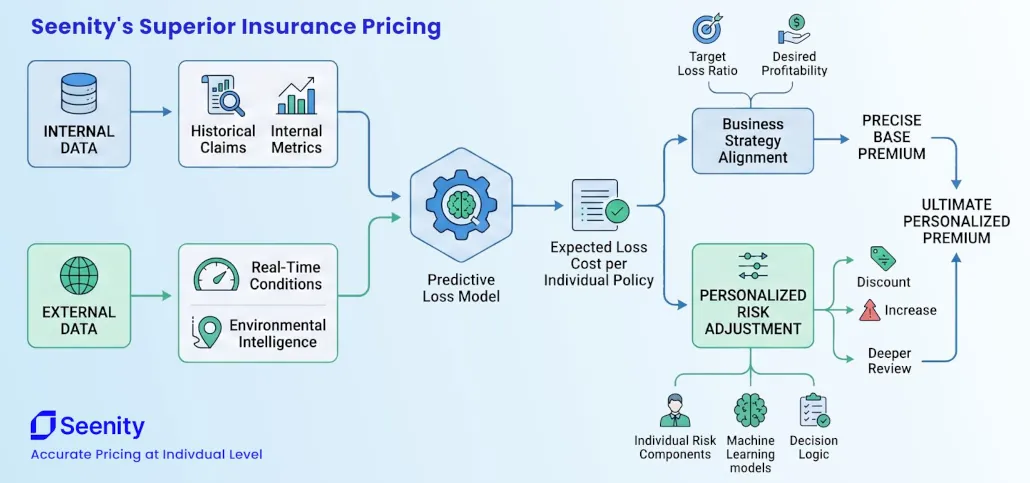
The first stage in Seenity’s process is creating a Predictive Loss Model – a model designed to estimate the expected risk cost for every individual policy.The model combines:- Historical claims data
- Loss probability and frequency analysis
- Hundreds of real-time external features
- Geographic and environmental intelligence
- Road conditions, weather data, accident zones, crime indicators, socioeconomic patterns, and more
Step 2 – Connecting Risk to Company Strategy
Once the system understands the actual risk, it aligns the pricing process with the insurance company’s business strategy.This stage includes:- Target Loss Ratio
- Operational and servicing costs
- Desired profitability
- Pricing strategy
- Underwriting policy
Step 3 – Personalized Risk Adjustment
This is one of Seenity’s strongest differentiators.After calculating the base premium, Seenity performs a personalized risk assessment to determine:- Whether to apply a discount
- Whether to increase the premium
- Whether the policy requires deeper review
- Whether underwriting conditions should be adjusted
- Machine Learning models
- Decision Logic
- Individual risk components
- Continuously updated external information
What Makes Seenity Extremely Fast?
One of Seenity’s major advantages is speed.
The platform is built for real-time operation:
- External data retrieval within seconds
- Fast API-based integration
- Real-time model execution
- Seamless integration into core insurance workflows
Instead of requiring multi-year transformation projects, Seenity can integrate into underwriting and pricing processes in a very short timeframe.
The platform also enables insurers to build and manage models without requiring deep MLOps or advanced data science expertise, using Agentic AI and advanced simulation tools.
Pricing Based on Reality – Not Only on Historical Data
Seenity’s philosophy is simple:
A person’s risk is influenced not only by who they are, but also by the world around them.
That is why Seenity builds models that connect:
- The individual
- The environment
- Time
- Behavior
- External intelligence
- Real-time events
The result is significantly more accurate pricing that leads to:
- Improved Loss Ratio
- Better fraud detection
- Smarter premium adjustments
- Higher profitability
- Faster service for trustworthy customers
No More Black Box Decisions
One of the biggest challenges in AI-driven insurance pricing is transparency.
Seenity was designed from the ground up to provide full explainability:
- Which features influenced the pricing decision
- Why the premium increased or decreased
- Which external signals contributed to the assessment
- What risks were identified
This means actuaries, underwriting teams, and regulators can fully understand, monitor, and improve the models.
Conclusion
Seenity represents a new generation of insurance pricing:
Not static statistical models,
but a living intelligence system that understands reality in real time.
By combining:
- AI
- Big Data
- External Intelligence
- Machine Learning
- Explainability
- Real-Time Processing
Seenity enables insurance companies to create pricing models that are more accurate, more personalized, more transparent, and significantly more profitable.
Most importantly:
It does so at the individual policy level, in real time, with full personalization for every insured customer.